

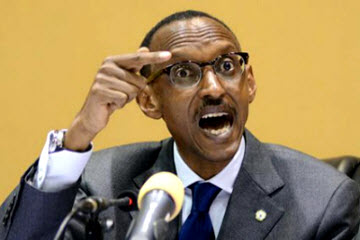
Rights groups are increasingly appalled at the support Mr. Kagame continues to receive from those who claim to be the leading defenders of human rights around the world, while at the same time providing support and cover for a man many consider a dictator, involved in war crimes across the border in eastern Congo, not to mention the suppression of any opposition to his regime by any means necessary.
Human Rights Watch, the Enough Project and the Open Society Foundations in Africa called this week on the United States to stop blocking a United Nations report containing evidence that top Rwandan officials, including Rwandan Defence Minister James Kabarebe and army Chief Charles Kayonga, have been supporting a new rebellion in eastern Congo led by infamous warlord Bosco Ntaganda, who is wanted by the International Criminal Court for war crimes.
A United Nations report released in 2008 provided evidence of direct links between the office of Mr. Kagame and rebels in eastern Congo led by Laurent Nkunda, Ntaganda’s predecessor as commander-in-chief of the rebel CNDP. Although Nkunda is now said to be “under house arrest” in Rwanda, an interim U.N. report on DR Congo released on Friday says that Rwandan officials have allowed the former warlord to make phone calls to urge former CNDP rebels integrated into the Congolese army to defect and rejoin Ntaganda. The new unrest has led to the displacement of over 200,000 civilians.
Why would the U.S. and the U.K. continue to support such a man? Mr. Kagame, whose troops are credited with stopping the Rwandan genocide in 1994, has been able to cast himself as the guarantor of the country’s stability and economic development. He has played the “genocide card” masterfully, promising gloom and doom if his regime were to fall. The Rwandan army has become one of the most powerful armies in the region, thanks in most part to military and financial aid from the United Kingdom and the United States.
Mr. Kagame has in return used the Rwandan army as leverage against his foreign backers. He has sent Rwandan troops as part of the African Union and United Nations force in Darfur. The A.U.’s force is supported by the United States.
Mr. Kagame successfully blackmailed the United Nations to remove the term “genocide” in a report released by the U.N. in 2010 that had initially said that the Rwandan army had committed genocide in reprisal attacks against Rwandan refugees who fled to eastern Congo after the genocide in 1994. All Mr. Kagame had to do to tame the U.N. was to threaten to remove the Rwandan troops from the A.U.’s contingent if the report was not watered-down.
As many critics point out, Rwanda’s current relative stability has come at a very high price for civilians in Rwanda, but even more so in eastern Congo. The repeated Rwandan support to rebels in the region has led to the world’s deadliest war since World War II and the deaths of over 5,000,000 Congolese civilians. Far more innocent civilians have died in Congo, as a consequence of wars during the last decade, than the civilians who lost their lives during the Rwandan genocide.
Some have claimed that the U.S.’ and the U.K.’s support to Mr. Kagame are driven by “guilt” for not intervening to stop the Rwandan genocide in 1994. The current U.S. ambassador to the United Nations, Ms. Susan Rice, was then a key advisor on Africa to President Bill Clinton. Ms. Rice has said that one of her biggest regrets was not doing more to intervene as the horrific events unfolded in 1994.
For Mr. Kagame to be given a license to kill and commit war crimes, 18 years after the dreadful events in Rwanda, because of “guilt” or military interests, is unconscionable.
How can the U.S. and the U.K. continue to claim they defend human rights and democracy around the world, especially in the Great Lakes region, while maintaining their support for dictators like Paul Kagame?
The U.S. has lost its credibility with many Congolese because of its continued support to Mr. Kagame, who most Congolese blame for the continued instability in eastern Congo.
U.S. President Barack Obama called Rwanda’s meddling in eastern Congo a “pretext” in the first bill he sponsored after becoming a senator in 2005. Now a Nobel Peace Prize laureate, President Obama and the United States should make sure they live up to the moral high ground they say they represent. The United States’ credibility and influence around the world depend on its actions rather than on words.

Related articles
- • 'Deadly environment' plus 'political and social' obstacles hinder Ebola fight, Security Council hears (July 24, 2019)
- • Ebola outbreak declared an international Public Health Emergency (July 17, 2019)
- • DR Congo Delays Results of December Election (January 6, 2019)
- • Jean-Pierre Bemba named MLC presidential candidate (July 13, 2018)
- • No elections in DR Congo in December without electronic voting machines: INEC (February 13, 2018)
- • US Warns DR Congo Against Electronic Voting for Delayed Election (February 12, 2018)
- • DRC Seeks Arrest of Presidential Candidate Moise Katumbi (May 19, 2016)
- • Peacekeepers, Congo Army to Resume Joint Fight Against Rwandan Rebels (January 28, 2016)
- • Political tensions 'running high' in DR Congo ahead of 2016 elections (October 7, 2015)
- • UN Report Blames Ugandan Islamists for 237 Killings in DR Congo (May 14, 2015)
- • Rights Groups: DR Congo Must Free Pro-democracy Activists (April 13, 2015)
- • DRC Army Putting Pressure on FDLR (April 1, 2015)
- • ICC Confirms 14-Year Sentence Against Thomas Lubanga (December 1, 2014)
- • ICC Case Against Bemba Wrapping Up as Another Opens (November 12, 2014)
- • Denis Mukwege Wins Sakharov Prize 2014 (October 21, 2014)
- • ICC confirms war crimes charges against Bosco Ntaganda (June 10, 2014)
- • Senior UN officials urge Brazzaville to halt expulsion of DR Congo nationals (May 26, 2014)
- • ICC sentences Germain Katanga to 12 years (May 23, 2014)
- • Kerry Calls on Kabila to Honor Constitution (May 4, 2014)
- • Kerry in DR Congo for Security Talks (May 3, 2014)
- • Security Council extends UN mission, intervention force in DR Congo for one year (March 28, 2014)
- • U.S. sending more personnel to Uganda to hunt LRA leader Joseph Kony (March 24, 2014)
- • ICC finds Germain Katanga guilty of war crimes and crime against humanity (March 7, 2014)
- • Bosco Ntaganda Attacked Civilians on Ethnic Grounds, ICC Prosecutor Says (February 10, 2014)
- • New DR Congo amnesty law welcomed by UN envoys (February 5, 2014)
- • Colonel Mamadou Ndala Is Killed in Ambush (January 2, 2014)
- • DR Congo, M23 Rebels Sign Declarations Marking End of Kampala Peace Talks (December 12, 2013)
- • DR Congo Honors Nelson Mandela, Hero and Model for Humanity (December 6, 2013)
- • No 'Peace Deal' With Defeated M23 Rebels, DR Congo Says (November 11, 2013)
- • Congo Will Not Sign a 'Peace Deal' With Defeated M23 Rebels, Government Says (November 6, 2013)
Tags: |