

Several years ago, human-rights activists around the world began advocating against what became known as ‘blood diamonds,’ jewels that fueled conflict in the Africa. Now, in the Democratic Republic of Congo, it is not the diamond trade financing local wars, but vast stores of minerals used to make cell phones, laptop computers and other electronics. A new U.S. law seeks to halt the trade of conflict minerals from Congo, but exporters say the law may only deepen the suffering of the Congolese people.
In the Congolese countryside, there is said to be $24 trillion worth of precious minerals like tantalum, tungsten, gold and tin. They are used to make everything from light bulbs to airplanes, and have long funded the conflict in the country’s tumultuous eastern provinces.
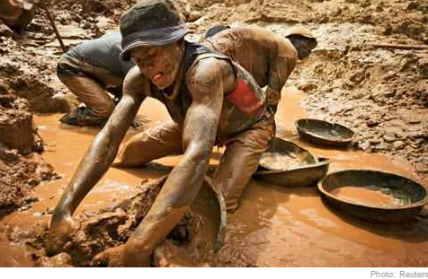
With as many as five-and-one-half-million people dead, and millions of others displaced in a war that only slowed when it officially ended in 2003, activists say they want the economic heartbeat of the conflict, the mining industry, to be demilitarized. The mines, they say, are often held by militias and worked by modern-day slaves.
Mines controlled by eastern Congo’s many militias pay for weapons and other war supplies. Civilian-owned mining companies pay so-called ‘taxes’ to any group of armed men controlling any given road. Rarely, if ever, do those taxes benefit the government or the people.
A researcher for human rights advocacy group, Enough, Fidel Bafilemba says mineral wealth only intensifies the suffering of the people in Congo, one of the world’s poorest countries. Militias supported by mines often use mass rape and looting to control the population, and force children to serve in the wars or in the mines.
"In Walikale, for instance, there [are] a number of armed groups, and they have been documented that they have been using children within the mines for digging and for transporting the minerals," Bafilemba stated.
Bafilemba says, if implemented, new U.S. regulations could bring some relief to the region. The Dodd-Frank financial law came into force on April 1, and requires public companies using minerals from Central Africa to document and report the path the minerals took from the Congolese earth to shelves in the West. Products that comply with the regulations can be labeled ‘DRC conflict free.’ If all minerals were tagged, traced and exported legally, activists say militias terrorizing the population could go out of business.
Conflict in Congo can be traced back before the turn of the 20th Century, but the current turmoil began after the 1994 genocide in neighboring Rwanda, when about a million ethnic Tutsis and sympathetic Hutus were killed in 100 days. After the genocide, Tutsi forces won the civil war, and about two-million Hutus fled to neighboring Congo, and then called Zaire.
Congolese exporters say tracing minerals from the remote mining areas may help bring peace to the region, but the process presents many challenges, and cannot be done overnight.
North Kivu Exporters Association President John Kanyoni says since the law went into force, the region has been reeling from what has become a de facto embargo on Congolese minerals. Hundreds of thousands of people are now out of work and he says more unemployment will only fuel the conflict. "Their mission of fighting against the violation of human rights will be putting people in situation where they will be jobless. And most probably those who will be jobless could join the armed groups," he said.
Kanyoni says the laws originated from Western companies under pressure from activists to prove their products were conflict-free. But he adds there is also another dynamic at play, lower coast minerals from Congo compete with those mined in the United States, Canada and Australia.
Next month, he will meet with purchasing companies and regulators in Paris and seek a way to sell Congolese minerals while taking steps to comply with the new regulations. If a compromise cannot be reached, he says, Congolese mining companies will look for new buyers among smaller companies in India and China.
And activists that support the law admit that separating the minerals from the conflict will not be easy, because it will require independent monitors to regulate the industry. At present, the United Nations is still trying to establish exactly who controls what mines in the eastern countryside - an area known for violence and poor roads.
The head of peace and natural resources at the Congo-based Center of Research on Environment, Democracy and Human Rights, Isaac Mumbere, says in some areas, mining companies and militias work together.
He says militias will sometimes have contracts with mining companies that allow commanders to take over operations for one or two days a week. The people will then be forced to do so-called "community work" in the mines for free. If they refuse, he says, they will lose their jobs with the mining company or be beaten until they comply.
Mumbere says the new regulations could help bring peace to the region. The trick now, he adds, is figuring out how they can be implemented.

Related articles
- • Ebola outbreak declared an international Public Health Emergency (July 17, 2019)
- • Constitutional Court Declares Tshisekedi Winner of Presidential Election (January 19, 2019)
- • At least 30 dead after massacres in Ituri (March 2, 2018)
- • No elections in DR Congo in December without electronic voting machines: INEC (February 13, 2018)
- • US Warns DR Congo Against Electronic Voting for Delayed Election (February 12, 2018)
- • Peacekeepers, Congo Army to Resume Joint Fight Against Rwandan Rebels (January 28, 2016)
- • DR Congo Scores High on Growth, Lags in Poverty Reduction: IMF (October 13, 2015)
- • Political tensions 'running high' in DR Congo ahead of 2016 elections (October 7, 2015)
- • UN Report Blames Ugandan Islamists for 237 Killings in DR Congo (May 14, 2015)
- • DRC Army Putting Pressure on FDLR (April 1, 2015)
- • ICC Confirms 14-Year Sentence Against Thomas Lubanga (December 1, 2014)
- • ICC Case Against Bemba Wrapping Up as Another Opens (November 12, 2014)
- • Denis Mukwege Wins Sakharov Prize 2014 (October 21, 2014)
- • Violence in North Kivu Kills 21, Mostly Women, Children (October 18, 2014)
- • Southern African Leaders to Meet in Zimbabwe (August 15, 2014)
- • Congo Improves Natural Resources Accounting (July 4, 2014)
- • ICC confirms war crimes charges against Bosco Ntaganda (June 10, 2014)
- • Kerry Calls on Kabila to Honor Constitution (May 4, 2014)
- • Kerry in DR Congo for Security Talks (May 3, 2014)
- • Security Council extends UN mission, intervention force in DR Congo for one year (March 28, 2014)
- • Death toll in Lake Albert boat accident rises to 251 (March 27, 2014)
- • U.S. sending more personnel to Uganda to hunt LRA leader Joseph Kony (March 24, 2014)
- • Bosco Ntaganda Attacked Civilians on Ethnic Grounds, ICC Prosecutor Says (February 10, 2014)
- • New DR Congo amnesty law welcomed by UN envoys (February 5, 2014)
- • Colonel Mamadou Ndala Is Killed in Ambush (January 2, 2014)
- • No 'Peace Deal' With Defeated M23 Rebels, DR Congo Says (November 11, 2013)
- • Congo Will Not Sign a 'Peace Deal' With Defeated M23 Rebels, Government Says (November 6, 2013)
- • Congo Army Takes Control of Mbuzi Hill From M23 Rebels (November 4, 2013)
- • Kabila Congratulates Congo Army for Defeating M23 Rebels (October 30, 2013)
- • Advancing Congo Troops Take Control of Rumangabo From M23 Rebels (October 28, 2013)